"How can you write if you can't cry?"
Ring Lardner
Wednesday, July 14, 2010


Tuesday, July 13, 2010
the scissors and the pencil
"I believe more in the scissors than I do in the pencil."
Truman Capote
Cutting passages and scenes you love, writing you've labored over with the sort of devotion and intensity a new mother shows her young,can be gut-wrenching. The only rule for me in writing is this: Does it work? If it doesn't, and many times we know it doesn't (even when we are in love with the sound of our own words), we must take out our scissors. Do it. Cut it. Cut it out all at once and be done with it. One sign of a good writer is the ability to see objectively, to know what works and what doesn't, and when it doesn't, to cut without mercy.
Truman Capote
Cutting passages and scenes you love, writing you've labored over with the sort of devotion and intensity a new mother shows her young,can be gut-wrenching. The only rule for me in writing is this: Does it work? If it doesn't, and many times we know it doesn't (even when we are in love with the sound of our own words), we must take out our scissors. Do it. Cut it. Cut it out all at once and be done with it. One sign of a good writer is the ability to see objectively, to know what works and what doesn't, and when it doesn't, to cut without mercy.
Monday, July 12, 2010
finding your writing springboard
From editor Malcolm Cowley's introduction to
Writers at Work: The Paris Review Interviews
The Viking Press, 1959
I haven't tried prayer. Maybe I should. What seems to work for me, as my springboard for writing, is reading interviews by writers on writing or finding words of inspiration from writers and those who love the writing life. I think it's that I need to feel both hopeful and empowered. I need to be reassured that producing work, even when it's not what I feel is my best effort, is better than not producing at all.
Teacher and novelist John Gardner writes about how every writer, no matter how many writing courses and workshops taken, no matter how many critique groups attended, is, in the end, on his or her own. Finding your way as a writer is partly about finding your springboard: that walk, that moment of prayer or meditation, that inspirational passage powerful enough to launch you into your working day.
What is your springboard for writing or other creative task?
Writers at Work: The Paris Review Interviews
The Viking Press, 1959
"Apparently the hardest problem for almost any writer, whatever his medium, is getting to work in the morining (or in the afternoon, if he is a late riser like Styron, or even at night). Thornton Wilder says, 'Many writers have told me that they have built up mnemonic devices to start them off on each day's writing task. Hemingway once told me he sharpened twenty pencils; Willa Cather that she read a passage from the Bible -- not from piety, she was quick to add, but to get in touch with fine prose; she also regretted that she had formed this habit, for the prose rhythms of 1611 were not those she was in search of. My spring-board has always been long walks.' Those long walks alone are a fairly common device; Thomas Wolfe would sometimes roam through the streets of Brooklyn all night. Reading from the Bible before writing is a much less common practice, and, in spite of Miss Cather's disclaimer, I suspect that it did involve a touch of piety. Dependent for success on forces partly beyond his control, an author may try to propitiate the unknown powers. I knew one novelist, an agnostic, who said he often got down on his knees and started the working day with prayer."
I haven't tried prayer. Maybe I should. What seems to work for me, as my springboard for writing, is reading interviews by writers on writing or finding words of inspiration from writers and those who love the writing life. I think it's that I need to feel both hopeful and empowered. I need to be reassured that producing work, even when it's not what I feel is my best effort, is better than not producing at all.
Teacher and novelist John Gardner writes about how every writer, no matter how many writing courses and workshops taken, no matter how many critique groups attended, is, in the end, on his or her own. Finding your way as a writer is partly about finding your springboard: that walk, that moment of prayer or meditation, that inspirational passage powerful enough to launch you into your working day.
What is your springboard for writing or other creative task?
Friday, July 9, 2010
character first, character foremost
"Character is the very life of fiction. Setting exists so that the character has someplace to stand, something that can help define him, something he can pick up and throw, if necessary, or eat, or give his girlfriend. Plot exists so the character can discover for himself (and in the process reveal to the reader) what he, the character, is really like: plot forces the character to choice and action, tranforms him from a static construct to a life like human being making choices and paying for them or reaping the rewards. And theme exists only to make the character stand up and be somebody: theme is elevated critical language for what the character's main problem is." John Gardner, On Becoming a Novelist
I think we are sucked in by writing workshops and the publishing industry to focus on plot first, the interesting premise, the unusual situation. Not that character is ignored, but that we hear a lot of talk like "consider what if ...", meaning what if this happened to someone (read plot) or "hook your reader with an exciting initiating event", meaning again soemthing unusual or exciting happened to someone (again plot). Much of what passes for good movies and books, to me, these days is based on gimmicky premises, "twist" endings, and plot-driven, souless escapades. In fact, the last two movies I've seen that come to mind where character is treated with the importance it deserves are Revolutionary Road and Brothers.
I don't know if this lack of concern for character is a result of having to fill the market commercially, a misdirection on the part of writers workshops, teachers, and editors, or an indication of the public's general bad taste. What we remember, when the movie is over or the last page read, especially months and years later, is that character we couldn't shake, those people we felt we knew, that we loved or hated or both. Where are the great character-driven stories these days?
Wednesday, July 7, 2010
Walking on Alligators
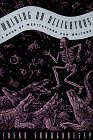
On Jacksonville's westside is a wonderful used bookstore, Chamblin Book Mine, a maze of room after room crammed full of every genre of writing one can imagine. I could spend days browsing its stacks. Today I found a book of meditations for writers, Walking on Alligators by Susan Shaughnessy.
Shaughnessy takes passages about writing from various writers and expands on them, providing for each passage an affirmation statement designed to motivate and inspire. She begins with this quote from Erica Jong:
"Everyone has talent. What is rare is the courage to follow that talent to the dark places it leads."
Shaughnessy follows the Jong quote with a short essay that invites us to take the journey of writing, wherever it may lead, even if we find ourselves "walking on alligators." She ends her remarks on Jong with this affirmation:
"Today, I will have the courage to go wherever my writing wants to lead me. I will not judge as I write. I will write, and write as honestly as I can."
Shaughnessy's meditations seem a wonderful way to start each writing session. I highly recommend it to those who write or want to start writing.
Tuesday, July 6, 2010
To edit is to edit is to edit is to .... Thanks, Gertrude
Today's task? Editing
Today's thought? "I try to leave out the parts that people skip." Elmore Leonard
Today's thought? "I try to leave out the parts that people skip." Elmore Leonard
Monday, July 5, 2010
"Clutter" Accepted for Publication
I received word today that "Clutter," a "slice of life" story I wrote for the Florida Writers Association's second collection of short stories, was accepted for publication. The collection contains sixty stories by FWA members and will be released at FWA's 2010 conference in Lake Mary, Florida October 22-24. I'm not sure what the FWA has planned for larger distribution, but hearing my piece was selected was a bit of welcomed news.
"Clutter" is a personal piece about my mother's hoarding behaviors and my worry for her and frustration with not being able to help her. It's intensely personal and makes me sad when I read it. It was one of those stories that grabs hold and won't let go until you commit it to paper.
Seeing the piece published will be both sweet and bitter. Anyone who knows a hoarder knows they can become deeply ashamed and baffled by their own behaviors. My mother is 81 and knowing I wrote about her obsession could cause her pain. I would never intentionally hurt her. I think as writers we often struggle with which, if any, parts or people of our personal life to share in our work. "Clutter" is the first work I've sent out for publication since making a serious effort at a writing career. I'm glad it was accepted. I'm sad, however, I can't share it with my mother. She would be very proud.
"Clutter" is a personal piece about my mother's hoarding behaviors and my worry for her and frustration with not being able to help her. It's intensely personal and makes me sad when I read it. It was one of those stories that grabs hold and won't let go until you commit it to paper.
Seeing the piece published will be both sweet and bitter. Anyone who knows a hoarder knows they can become deeply ashamed and baffled by their own behaviors. My mother is 81 and knowing I wrote about her obsession could cause her pain. I would never intentionally hurt her. I think as writers we often struggle with which, if any, parts or people of our personal life to share in our work. "Clutter" is the first work I've sent out for publication since making a serious effort at a writing career. I'm glad it was accepted. I'm sad, however, I can't share it with my mother. She would be very proud.
Subscribe to:
Posts (Atom)